Every Material, and Why
The story and science behind every material in the Petal + Ash launch collection.
If you've been following along, you know what Petal + Ash — the lingerie brand I’m building — stands for. If you're new, here's the short version: To create beautiful, timeless lingerie, made to move and breathe with your body — crafted from nature, and designed to return to it.
For those who want the full story behind every choice, it’s all below. If you’re looking for the TL;DR: every material in this collection was chosen with the utmost intention to best support your body and the planet.
Whether you’re here because you’re excited for launch or you're here to learn about better materials, I think you’ll find this essay interesting. I’ve been knee deep in research and development for years now, working up to this thrilling moment where I can finally debut each material chosen for the Petal + Ash launch collection.
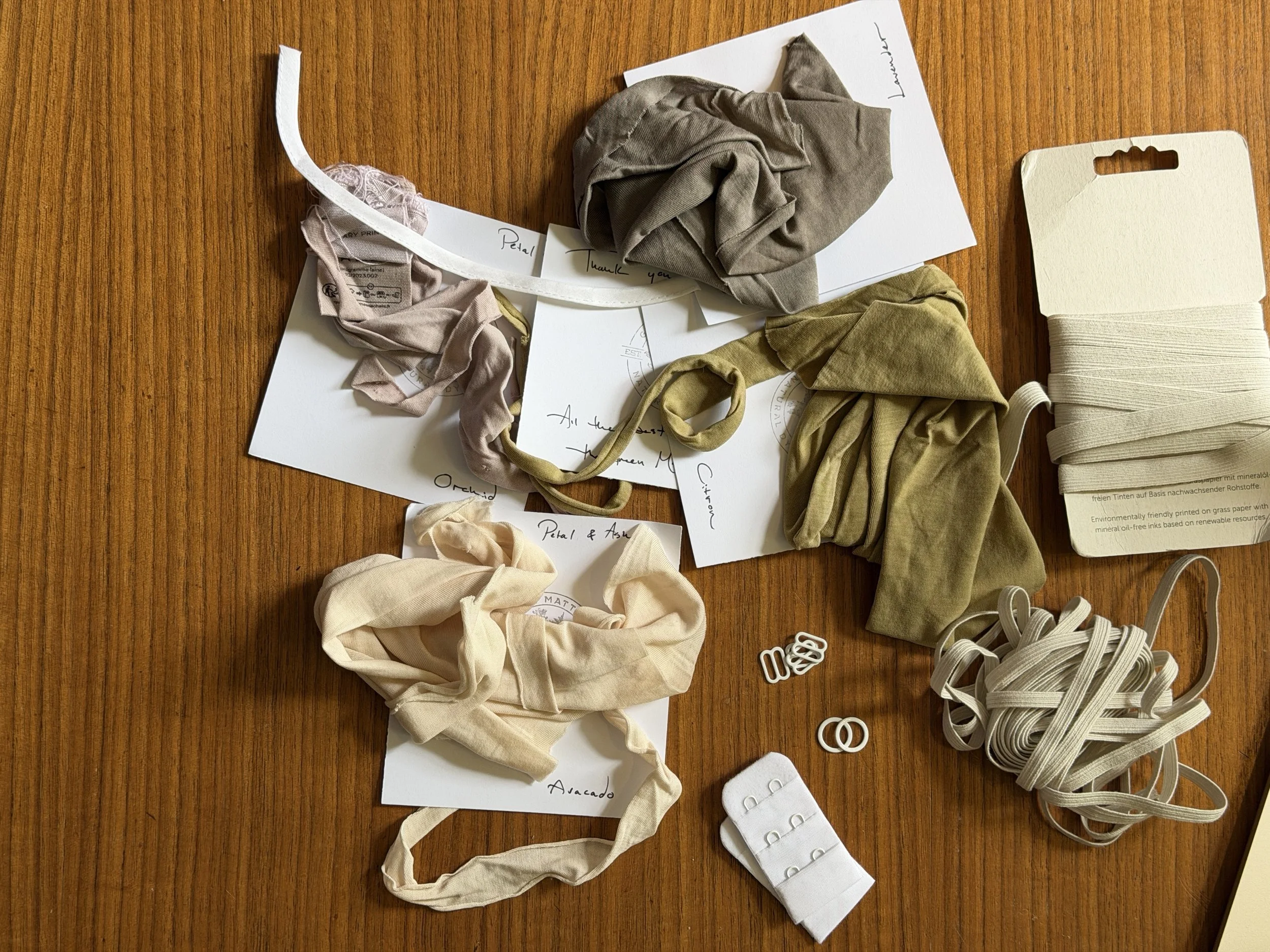
Petal + Ash launch collection materials
Material Tradeoffs
The lingerie category is known for gorgeous materials like lace, mesh, power mesh, satin, silk, charmeuse, chiffon. While they are beautiful, they come with some nasty truths.
Most of these, with the exception of silk, are petroleum-based. They come from fossil fuels, making them essentially plastic.
Silk is a stunning natural fiber, and takes natural dyes beautifully, but nowadays it’s often blended with elastane, which is...you guessed it: petroleum based. Unless it’s peace silk (which isn’t always great for lingerie), it typically involves sacrificing the silkworm to produce. Regenerative silk is an amazing option for land restoration or regeneration, but it still calls upon traditional methods of sacrificing the worm. Cotton, which seems to be the natural fiber of choice for undergarment basics — whether conventional or organic — just doesn't have the same gorgeous hand as silk or these other synthetics that we've come to associate with lingerie.
Silk was actually the first material I experimented with, sewing a bra and panty from a regenerative silk jersey. (Yes, there was a long way to go with the design here, too, all materials aside).
I had found an amazing mill that was restoring the land they used to farm the silkworms. I was still struggling with the ethics to spin silk into a fiber, and despite the incredible work this mill was doing, it was halfway across the world, which meant shipping this material would come with increased carbon emissions, and a larger impact to the environment.
When I hit a literal snag with the materials performance for my needs, I had to listen — and consider that I might find a more suitable option for my current design needs.
So before we get into how much I love our debut materials, how much I believe in them, and how luxurious they are, I want to level set: there is no perfect material, no zero-impact decision. Every material comes with tradeoffs. The question then becomes what is the best material for this use.
Fabric: The Seacell/Lyocell story (Portugal)
The birth of development for our launch fabric began in London, 2023 at the Future Fabrics Expo. I was there on a sourcing trip, through the support of a Columbia University grant I’d won while there pursuing my masters in sustainability.
I originally fell in love with a 100% Seacell™, a new fiber with the addition of seaweed: offering natural minerals, antioxidants, vitamins within the fiber, not to mention amazing moisture-regulation. Unfortunately, after some testing, the fabric fell a little short in terms of durability. In conversations with the makers of this fiber, and recognizing the harmony between it and lyocell, I decided to move to a blend: 20% Seacell™ to naturally nourish the skin; 80% lyocell to enhance the durability required for lingerie.
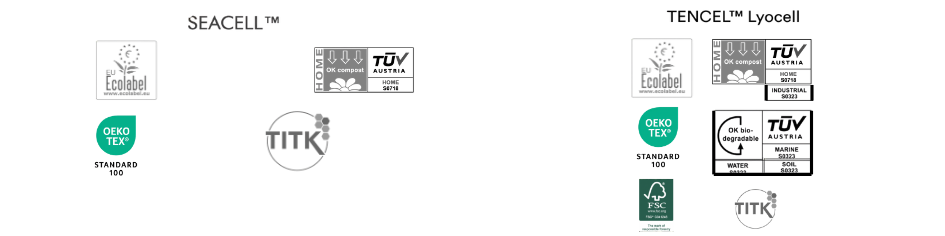
Our lyocell fibers are responsibly harvested from eucalyptus, birch, and seaweed, from an amazing manufacture. Both fibers are produced by dissolving plant-matter in a process where no chemicals are released (for you sustainability nerds, this is called a closed-loop process. It’s a circular system). Both fibers are third-party certified compostable and biodegradable.
Elastics (Austria)
Organic cotton from Turkey, sourced through controlled organic cultivation, and FSC certified natural rubber from Malaysia. I source these from a small company that designs in Germany and produces in Austria.
Hardware (France)
Nickel-free nylon-coated steel from a 50-year-old manufacturer in France.
Integrity gets complicated here, and I want to be honest about the tradeoffs. We originally sampled pure metal zamak hardware, in service of eliminating all synthetics from lingerie. But our natural dyes contain tannins that react with copper found in zamak, and it left marks on the garments. So I had a choice: keep the pure metal and accept marked garments, or switch to nylon-coated steel and compromise — for now. As tough as this call was, I couldn’t let perfect be the enemy of good. And a beautiful, unmarked garment that lasts, serves you better than an ideologically pure one that disappoints upon arrival. I'm watching the hardware market. As soon as there's a better option that doesn't react with natural dyes, we're switching.
Tradeoffs also extend to the hook & eye closures. As a small company we only have access to what's already being produced. So it was either conventional, or not at all. Including a hook & eye closure felt truly necessary for comfort/adjustability/longevity of the garment. As we grow we'll be able to custom produce hook and eyes from our fabric, so this is something we'll be working towards.
Thread (Portugal)
100% Tencel™, manufactured in a facility that tracks and minimizes water and carbon use.
The Full Picture
The materials for our launch bra and thong set are sourced entirely from Europe. Manufactured in Portugal. Dyed here in the United States with natural dyes; no harsh chemicals or finishers. (Dye deep dive coming soon).
I’m really proud of the regional localization of my supply chain. As a US-based brand, would I love everything to be made here? Absolutely. However, this just isn’t the reality. Most of the materials are only being produced in Europe as of now.
But where I’m even more excited is the end-use for these garments. When you’ve finally worn this set out, you won’t throw it away. You’ll remove the hardware and safely compost the rest. Because returning to Earth is as important as being beautiful now. Yes, our set fully reverts to nature, once in the proper biological environment.
Why This Matters
What touches your skin 12+ hours a day shouldn’t just look beautiful. It should move and breathe with your body. It should feel like an extension of you. It should support coming home to yourself.
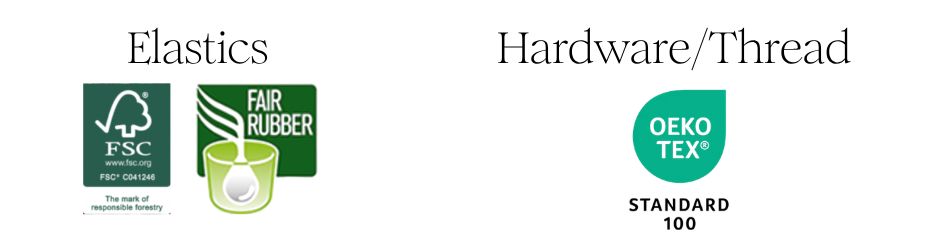
You don’t just have to trust my word. These materials are backed by third-party certifications: OEKO-TEX Standard 100 (free from harmful substances), European EcoLabel (environmental excellence), FSC (responsible forestry), Fair Rubber (ethical sourcing), and OK compost HOME/TÜV AUSTRIA (fully compostable and biodegradable). Every claim has proof behind it.
Because what you wear closest to your skin deserves the most consideration.